How to Write a Eulogy: A Gentle Guide With Examples for Mum, Dad and a Friend
A calm, step-by-step guide to writing and reading a eulogy: what to include, how long it should be, and short examples for a mum, a dad and a friend, plus a printable planner.

Being asked to speak at a funeral is an honour, and it can also feel like a lot to carry when you are grieving. If you are wondering how to write a eulogy, take heart: it doesn't need to be perfect or polished. It just needs to sound like you, talking about someone you loved. This guide walks you through it step by step, with short examples for a mum, a dad and a friend.
What is a eulogy?
A eulogy is a spoken tribute to the person who has died, usually given during the funeral or memorial service. It shares who they were: the life they lived, the people they loved, and the little things that made them them.
It's a little different from a funeral notice, which is a short written announcement with the service details, and from a reading or poem, which someone else has written. A eulogy is personal. It can be given by one person, shared between a few family members, or read by the celebrant on the family's behalf.
The Queensland Government's guidance on funeral arrangements lists the eulogy among the things worth talking about as a family before you meet with your funeral director, alongside music, flowers and whether to have a viewing. So if you are starting to think about it now, you're right on time. (If the death has only just happened, our guide to what to do when someone dies covers the first practical steps.)
How to write a eulogy in six steps
Take these steps one at a time. You'll find a printable planner with space for your own notes at the end of this section.
1. Check the time you have
Before you write a word, ask your funeral director or celebrant how long you'll have to speak, and whether anyone else is also giving a tribute. Many venues book services in set time slots, so knowing your share of the time early saves a lot of cutting later. If several people are speaking, agree on who will cover what, so stories aren't repeated.
2. Gather memories
Sit down with a cuppa, a notepad and, if you can, a few people who knew them well. Look through photos, old cards and messages. Some questions to get you started:
- What did they love doing on a weekend?
- What did they always say?
- What would they be doing on a perfect Mackay afternoon?
- What are you most grateful they taught you?
- What story does everyone tell about them?
Write everything down, even the small things. The small things are often what people remember most.

3. Pick a few themes
You can't fit a whole life into a few minutes, and you don't need to. Choose two or three themes that sum them up, such as "generous to a fault", "never missed a footy game" or "the heart of every family gathering". Then pick one or two short stories that show each theme in action.
4. Build a simple structure
A eulogy that flows well usually has three parts:
- A beginning. Introduce yourself and how you knew them: "For those who don't know me, I'm Sarah, Jim's eldest daughter."
- The middle. A brief outline of their life (where they grew up, work, family, passions) woven together with your themes and stories. You don't have to tell it in strict date order.
- An ending. A closing thought, a thank you, or a few words spoken directly to them. It should feel like a natural place to stop.
5. Write it to be spoken
A eulogy is heard, not read, so write the way you talk. Use short sentences, everyday words and the nicknames everyone knew. Leave out long lists of dates and places; one or two key ones are enough. Humour is welcome if it fits the person. A gentle laugh in the middle of a sad day can be a real gift.
6. Read it aloud and share it early
Read your draft out loud, ideally to someone you trust. You'll hear where it trips you up and where it runs long. Then send a copy to the celebrant before the deadline they give you. That lets them check names and dates, plan the order of speakers and have a copy ready in case you need someone to step in.
Printable planner
Your six-step eulogy planner
Jot down a few notes under each step as you go. Print it with your notes, or print it blank and write by hand.
Check the time you have
How many minutes? Who else is speaking, and what will they cover?
Gather memories
Photos, cards, sayings, favourite places, the stories everyone tells.
Pick a few themes
Two or three qualities that sum them up, with a short story for each.
Build a simple structure
A beginning (who you are), a middle (their life and your themes), an ending.
Write it to be spoken
Short sentences, everyday words, the nicknames everyone knew.
Read it aloud and share it early
Time yourself, then send a copy to the celebrant before their deadline.
Your notes are saved in this browser on this device only. Nothing is sent to us.
How long should a eulogy be?
Most eulogies run for about three to five minutes. As a rule of thumb, spoken at a calm pace, that is roughly 400 to 700 words. If yours is the only tribute, it may be a little longer; if three or four people are sharing the time, each piece will be shorter.
Your celebrant will usually guide you on length in minutes rather than word count, based on the overall service. When in doubt, shorter and heartfelt beats long and rushed.
Interactive
Eulogy length calculator
Slide to the time you have been given to see roughly how many words to aim for.
For 4 minutes of speaking
About 520 to 560 words
Within the usual three to five minutes.
Paste or type your draft above to see an estimate.
A rule of thumb only, based on a calm speaking pace of about 130 to 140 words a minute. Your draft stays on your screen and is not sent anywhere. Your celebrant will guide you on timing.
What to include (and what to leave out)
There are no strict rules, but these are good things to draw from:
- their full name, any nicknames, and where they were born and grew up
- family: parents, siblings, partner, children and grandchildren
- work, trades, study or military service
- hobbies, clubs, sport and community involvement
- personal qualities, values and favourite sayings
- a funny or touching story or two
- what they meant to you, and the legacy they leave
It's usually best to leave out family disagreements, private medical details and inside jokes that only a few people would understand. If you're unsure about something, ask yourself whether they would be happy to hear it said in front of everyone.
Eulogy examples
These short passages are examples only, with made-up names, to show tone and structure. Borrow the shape, then fill it with your own memories.
MumA eulogy for mum (example)
“For those who don't know me, I'm Lisa, Margaret's youngest. Mum had a way of making everyone feel like the most important person in the room. Our kitchen in Andergrove was never quiet; there was always a pot of tea on, a neighbour dropping in and a cake cooling on the bench that she swore was ‘nothing special’. She worked for years as a nurse, and she brought that same care home every day. Mum, thank you for the hugs, the lunchboxes and the endless patience. We'll keep the kettle on for you.”
Why it works: Opens with who is speaking, paints one clear picture (the busy Andergrove kitchen), links it to her work and care, and closes with words spoken to her.
DadA eulogy for dad (example)
“I'm Tom, Ray's son. Dad was a man of few words, but he showed his love in what he did. He was up before dawn for most of his working life, and on weekends you'd find him in the shed or out on the water off Seaforth, hoping the fish would be kinder than last time. He taught me how to change a tyre, how to back a trailer and how to shake a man's hand properly. Most of all, he taught me that you look after your family. Dad, we've got it from here. Rest easy.”
Why it works: Shows love through what he did rather than lists of dates, uses a familiar local place, and finishes with a short, steady promise.
FriendA eulogy for a friend (example)
“My name is Jess, and I've had the joy of being Kate's friend since Year 8. Kate was the friend who turned up: with soup when you were sick, with a playlist for every road trip up to Airlie, and with a terrible joke when you needed it most. She loved big and laughed loudly, and she made the rest of us braver. Kate, thank you for every adventure. I'll miss you every single day, and I'll keep telling your terrible jokes.”
Why it works: Starts with how long they were friends, gives three quick, specific moments, and ends on a smile that sounds just like her.
Tips for reading a eulogy on the day
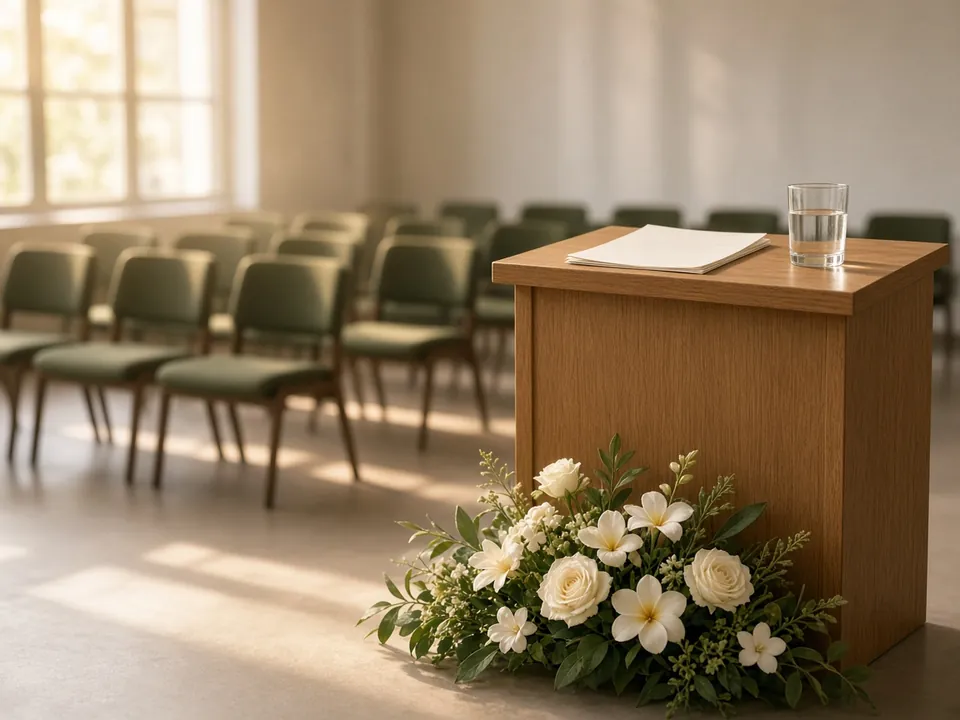
- Print it in a large font, with wide spacing, and number the pages.
- Mark places to pause and breathe. It's fine to take your time.
- Bring a glass of water and a tissue to the lectern.
- Have a back-up reader. Give a copy to a family member or the celebrant, so they can carry on if you need them to.
- Look up now and then. Find a friendly face in the room and speak to them.
- Let the emotion come. If your voice breaks, stop, breathe and continue. Everyone in that room is on your side.
If you can't do it, or don't want to
Not everyone feels able to stand up and speak, and that's completely okay. A few other options:
- Ask the celebrant to read it. You can write the eulogy and have the celebrant deliver it for you.
- Share the load. Two or three people can each speak briefly.
- Ask for help writing it. Celebrants regularly help families gather memories and shape a tribute. Our celebrants and ceremonies page explains how this works.
- Add a photo tribute. A slideshow set to their favourite song can say a great deal alongside a shorter eulogy.
Whatever kind of service you're planning, whether it's a memorial service, a church funeral or a simple gathering after a water cremation, there is always room for words about the person you love. And if you'd like to jot down your own memories or wishes ahead of time, a free pre-planning chat is an easy place to start.
Frequently asked questions
How long should a eulogy be?
Most eulogies run for about three to five minutes, which is roughly 400 to 700 words spoken at a calm pace. Check with your funeral director or celebrant, as the time available depends on the overall service and how many people are speaking.
Who usually gives the eulogy?
A eulogy is often given by a close family member or friend, but there is no rule. It can be shared between several people, or written by the family and read by the celebrant.
What should I say in a eulogy for my dad or mum?
Introduce yourself and your relationship to them, share a brief outline of their life, then focus on two or three qualities you loved, each with a short story. Finish with a thank you or a few words spoken directly to them.
Is it okay to use humour in a eulogy?
Yes, if it suits the person. A gentle, affectionate story that makes people smile can be a lovely way to remember someone. Avoid jokes that might embarrass them or upset others.
What if I get too emotional to finish?
That's very common and nobody will mind. Pause, take a breath and continue when you're ready. Give a copy to the celebrant or a family member beforehand, so they can read the rest if needed.
Can Gentle Way Funerals help with writing a eulogy?
Yes. Gentle Way Funerals can connect you with a celebrant who helps families gather memories and shape a eulogy, and can read it on the day if you prefer. Call (07) 4881 0491, any time.
We're here to help
Writing a eulogy is one of the last loving things you can do for someone, and you don't have to work it out alone. If you're planning a farewell in Mackay, Proserpine or anywhere across the Whitsundays, call our local team on (07) 4881 0491, day or night. We can talk through the service, introduce you to a celebrant and help with the order of service. You can also contact us online.
Day or night, 24/7
Call us any time
Our local Mackay team is here for you, every hour of every day.
Call (07) 4881 0491Help with the words
Talk to a celebrant
A celebrant can help you gather memories, shape the eulogy, and read it on the day if you prefer.
Celebrants and ceremoniesWalk-ins welcome
Come and see us
1C/17 Evans Ave, North Mackay QLD 4740
Office hours 9am–4pm, Monday to Friday.
In the Whitsundays: Shed, Building J, 4A/2 Mann St, Proserpine QLD 4800.
Sources
- Queensland Government, After a death (funeral arrangements, including the eulogy)
- Queensland Government, Arrange a loved one's funeral
- Metro North Health (Queensland Health), Funeral, memorial, burial or cremation arrangements
- Australian Federation of Civil Celebrants, Writing a eulogy (or tribute)